
How does a cultural unit move?
- Repetition, reconstruction, and diffusion
- Competition for attention and persistence
- Transformation during transmission
WEME Theory
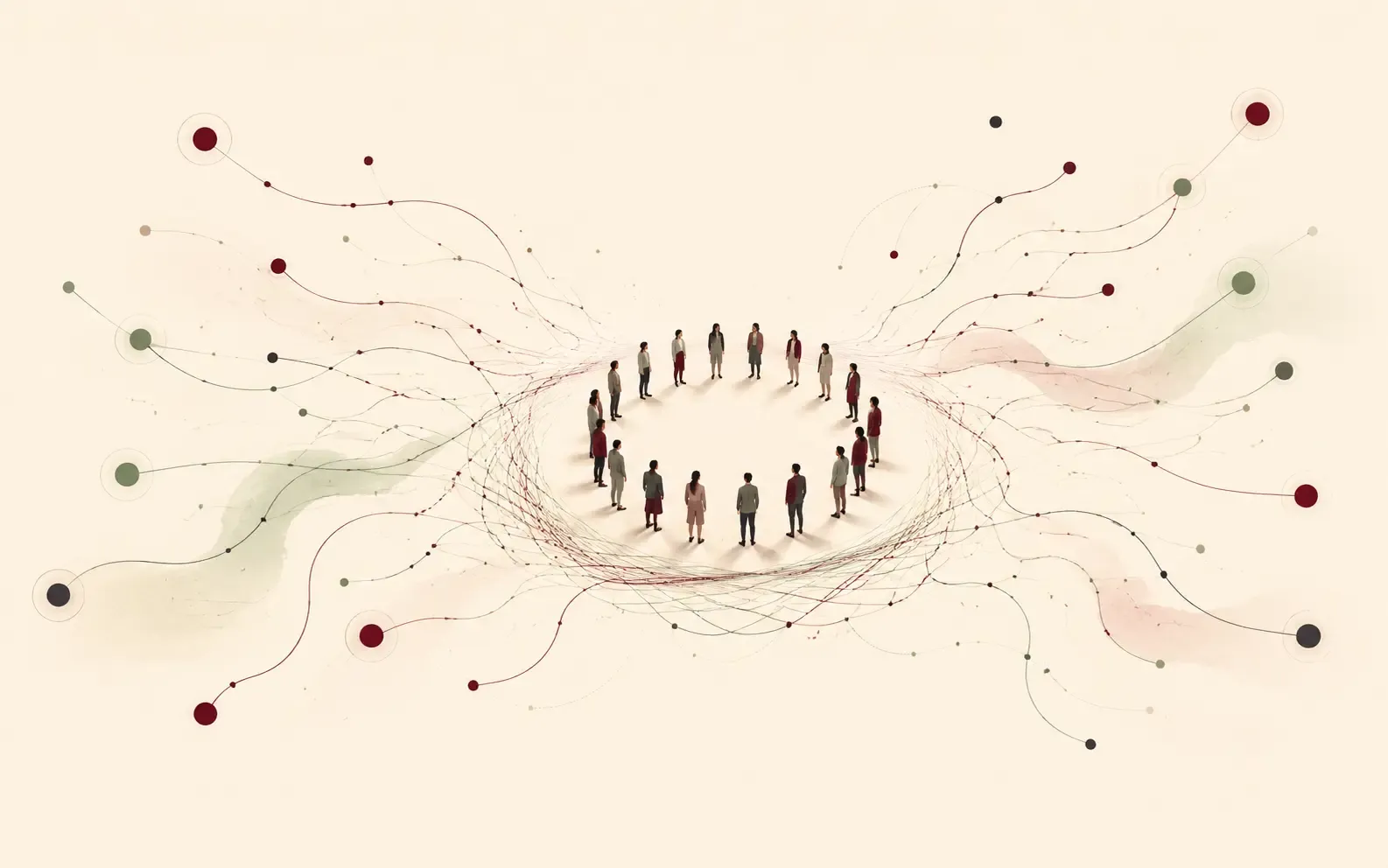
Some ideas merely spread. Others become connected to identity, roles, and action so strongly that people attribute intention, outcomes, and responsibility to a ‘we.’ WEME is a theory of that transition.
A Simple Definition
WEME is a communicative process. A family of related narratives changes over time while preserving a recognizable relationship among ‘who we are,’ ‘what matters to us,’ and ‘what people like us do.’ These roles connect to visible actions; outcomes are attributed to the collective; and those outcomes select or transform the next narrative variants.
Meme and WEME
WEME is not intended to replace meme theory. It asks a different question and follows a different unit.
A WEME is not a ‘larger meme,’ a cultural genome, a virus, or a living organism. The analogy with cultural evolution is useful only when translated into observable relationships such as repetition, transformation, recombination, and branching.
The Identity–Action Schema
Sentences, images, and examples can change. What keeps a lineage recognizable is a relationship, not a fixed phrase.
The boundaries of identity and membership, the right to speak, and what lies outside this ‘we.’
A shared experience, injustice, possibility, threat, inheritance, or future that gives the narrative weight.
The role through which a member builds, refuses, repeats, protects, or brings something into being.
A Recursive Process
The stages are not always separate or slow. In a digital wave, enactment, interpretation, and the retelling of an outcome may occur within minutes.
Multiple variants, symbols, and stories circulate.
An identity–meaning–role relationship persists across some variants.
An audience recognizes the act as an enactment of the narrative role.
Intention, action, outcome, or responsibility is connected to a collective address.
Success or failure preserves, changes, or divides the narrative variants that follow.
Outcome × Collective Attribution × Variant–Role Linkage
An outcome changes a narrative more selectively when it is attributed both to a ‘we’ and to a particular role within the narrative.Six Possible Trajectories
A successful role stabilizes as contradictory repetition declines.
The form or method changes while the identity and main direction remain recognizable.
Two narrative branches borrow some roles or meanings from one another.
Related branches produce incompatible roles and competing versions of ‘we.’
The narrative becomes embedded in rituals, tools, habits, and durable rules.
Repetition, recognition, enactment, or the attribution of outcomes gradually disappears.
The Academic Formulation
The academic formulation defines WEME as a meso-level, temporal, and testable process and proposes seven falsifiable propositions for future research.