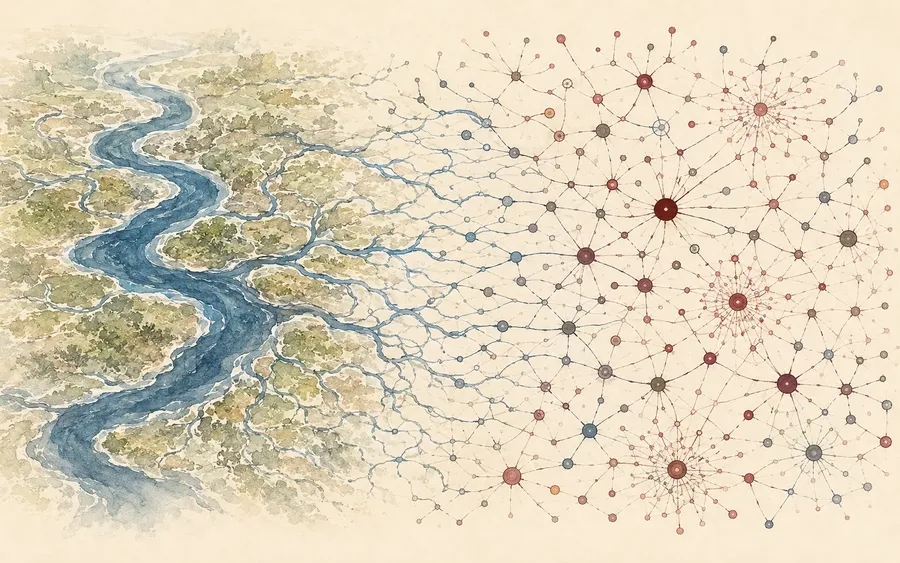
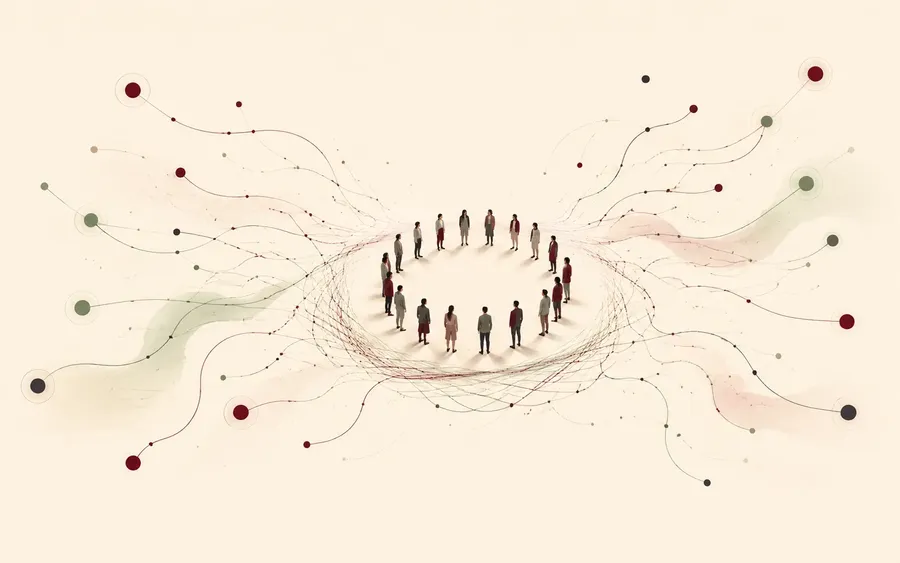
Some phrases appear everywhere. People repeat them, create new versions, and even turn them into jokes. Yet when we ask, ‘Who exactly does this phrase belong to? What does it ask its members to do? And who is responsible for the outcome?’ there is no clear answer.
We therefore need to distinguish between the popularity of a narrative and the formation of a collective actor. WEME is a theory of that gap: how a changing family of narratives becomes linked to recognizable roles and gradually creates a social address to which people can attribute an intention, an action, or an outcome—a ‘we.’
A WEME Is Not Simply a Larger Message
A post, slogan, image, or short story can be one narrative variant. Related variants that are quoted, reconstructed, or adapted from one another over time form a narrative lineage. A WEME is neither one of those variants nor the group that repeats them; it is the process that connects the lineage to action and to the attribution of outcomes.
Not everything viral is therefore a WEME. Millions may see an image without knowing what membership in its narrative means or which action signals belonging. Extensive reach can occur without collective actorhood.
The Three Questions at a Narrative’s Core
For different variants to remain recognizable as members of one family, a relatively stable relationship usually links three things: ‘Who are we?’, ‘What situation, suffering, possibility, or future matters to us?’, and ‘What do people like us do in response?’ I call this relationship the identity–action schema.
A narrative does not have to state all three aloud. For people familiar with it, a photograph or a brief gesture may activate the entire relationship. The point is that membership must be more than a name; it must connect to a role that can be enacted.
The meme asks how a cultural unit is transmitted; WEME asks when a narrative lineage becomes connected to action, outcomes, and a recognizable ‘we.’
When a Role Becomes Visible and Recognizable
A private act may be meaningful to the individual, but it is not enough to create a collective actor. The act must be visible to a relevant audience and, more importantly, interpretable: others must recognize it as an example of ‘what people in this narrative do.’ Public does not necessarily mean appearing before millions. A small sign within a limited circle can be clearer than a spectacular display.
As such actions recur, participants and observers gradually begin to use a shared address: ‘We did this,’ ‘They succeeded,’ or ‘This group is responsible for that outcome.’ This convergence in attributing intention, action, and responsibility creates a degree of collective actorhood.
Outcomes Change the Narrative Again
The theory’s diagnostic core lies in the return path. An action produces an outcome: success, failure, opposition, suppression, or an unforeseen consequence. But outcomes do not speak for themselves. Participants, media, leaders, and opponents decide where credit or blame belongs and which role it should be connected to.
When success is attributed to a particular method, variants prescribing that role are likely to be repeated more often. When failure is attributed to a tactic, the ‘what we do’ component changes; when failure is attributed to the identity or purpose of the group itself, division or collapse becomes more likely. In both cases, the outcome returns to the narrative lineage and shapes its future.
What Does WEME Make Visible?
WEME does not claim to have discovered narrative, identity, diffusion, collective action, or feedback for the first time. Its value lies in arranging these units precisely along a testable temporal path: the variants that preceded action, the role that was enacted, the audiences that recognized it, the outcome attributed to a ‘we,’ and the variants that subsequently became more or less common.
This view also reveals an important paradox: a narrative can gain more views every day while its ‘we’ becomes weaker. When branches within a lineage prescribe incompatible roles, attention rises but it becomes unclear who can speak or act in the collective’s name. Visibility is not the same as the capacity to act.