One Shape, Four Different Worlds
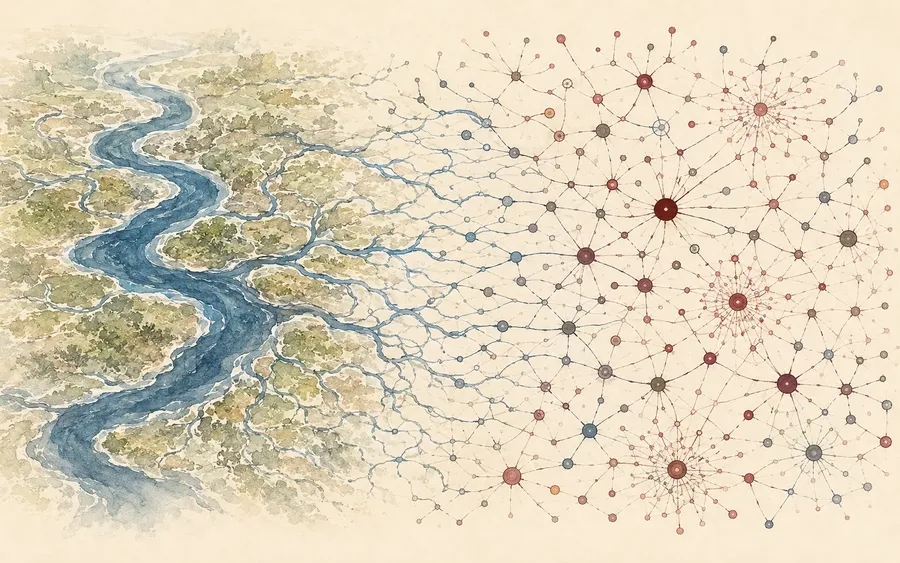
Place an image of the inside of a lung beside a river map and the roots of a tree, and you may notice a curious resemblance before you notice their differences. In each, a main pathway branches repeatedly, reaches smaller channels, and eventually disappears into a network of fine divisions.
The trachea divides into bronchi and then narrower airways to carry air to millions of alveoli. A tree’s primary root extends into lateral roots and finer hairs to collect water and minerals from scattered points in the soil. Streams join rivers, rivers form larger flows, and near the end of some journeys, a river divides again into numerous channels.
Even the internet, despite its distance from the natural world, produces a broadly similar picture at first glance: large networks, intermediate nodes, and local routes that carry information from one point to many others.
But why? Why do structures produced by evolution, erosion and gravity, and human design sometimes look so alike?
The answer may lie less in what these structures are made of than in the problem each must solve. A lung must distribute air from one inlet to millions of destinations. Roots must gather dispersed resources and carry them into the tree. A river collects water across a broad landscape and channels it through limited routes. The internet must move information among an enormous number of senders and receivers.
Despite their fundamental differences, all of them confront the problem of flow.
This is not a universal law, nor should every branching structure be treated as evidence of one hidden order. A river did not evolve like a lung, and a root was not designed like the internet. Entirely different processes can produce outwardly similar forms when they face similar constraints and problems.
Whenever something must flow between one point and thousands of destinations, its structure often begins to resemble roots, rivers, and lungs.
Flow Requires a Path
When something has to move across a wide space, a single direct route is rarely enough. The main route must divide. Each branch must carry part of the flow to a point the main channel could never reach directly.
A tree trunk cannot touch every leaf. The trachea cannot connect directly to every alveolus. A great river cannot encompass its surrounding geography without streams and smaller tributaries.
Flow requires more than force. It also requires a path.
Visibility Is Not Always Flow
I have been thinking about visibility and influence for a long time. We often treat the two as nearly identical. We assume that the more people see a message, the more influential it must be. So we try to amplify the voice: we publish more content, gather larger audiences, run broader campaigns, and turn to people whose voices are already heard.
These efforts may expand a message’s reach. But visibility does not always mean that something has begun to flow.
A piece of content can receive millions of views in a day and leave almost no trace a few days later. It may capture attention for a moment without changing anything in the audience’s memory, behaviour, relationships, or identity. The message has travelled, but it has not built a path.
Virality may be closer to a flood. A huge volume of water passes through a place in a short time. Everyone sees it and talks about it, yet the flow subsides almost as quickly as it appeared. A flood can be powerful, but power does not always produce endurance.
Sustained influence is more like a river.
A river does not merely cross a landscape; by crossing it repeatedly, it changes that landscape. It forms a bed, moves soil, opens new routes, and makes life possible around it. A river’s power lies not only in the volume of water it carries, but also in the path it has built and the network that feeds it.
To Endure, an Idea Must Branch
Ideas need pathways of this kind as well.
An idea heard only in the voice of its creator still depends on that person. It remains alive only while its creator speaks, writes, or stays present. The idea may be important, profound, even transformative; but if it cannot travel beyond its originator, it will stop when that voice falls silent.
To endure, an idea must branch.
Those branches are not limited to media channels, communication tools, or high-reach accounts. The most important pathways of a narrative are often people who retell it in their own words, groups that connect it to a shared experience, and small circles that turn an abstract message into part of everyday life.
The narrative will not remain unchanged along the way. People add parts of their own experience. Some sentences become simpler. Examples change. The story adapts to the language, culture, and concerns of each group. Such change is not always distortion. Sometimes it is precisely what allows meaning to survive in a new environment.
Roots do not grow in exactly the same way through every part of the soil. They turn when they meet stone. In dry ground, they travel farther in search of water. Some branches stop while others expand. Yet all these divisions still belong to one living system.
An enduring narrative must also be able to change without losing its core altogether.
From Spreading a Message to Forming a ‘We’
This is where the difference between distributing a message and creating a flow becomes visible. Distribution occurs when many people see or repeat something. A flow emerges when that message enters the relationships among people, gives them a shared language, appears in their choices and actions, and changes how they see themselves and others.
At that point, we are no longer dealing only with a sentence, an image, or an idea. We are dealing with a ‘we.’
In my book Man Manam, I call this mechanism a WEME.
WEME can be understood as an extension of the meme concept, though the two are not identical. The meme directs our attention to cultural units that move from mind to mind: a sentence, image, melody, behaviour, or idea that is repeated and spreads.
WEME, however, is not only about what passes between people. It is about what happens among people as that transmission takes place.
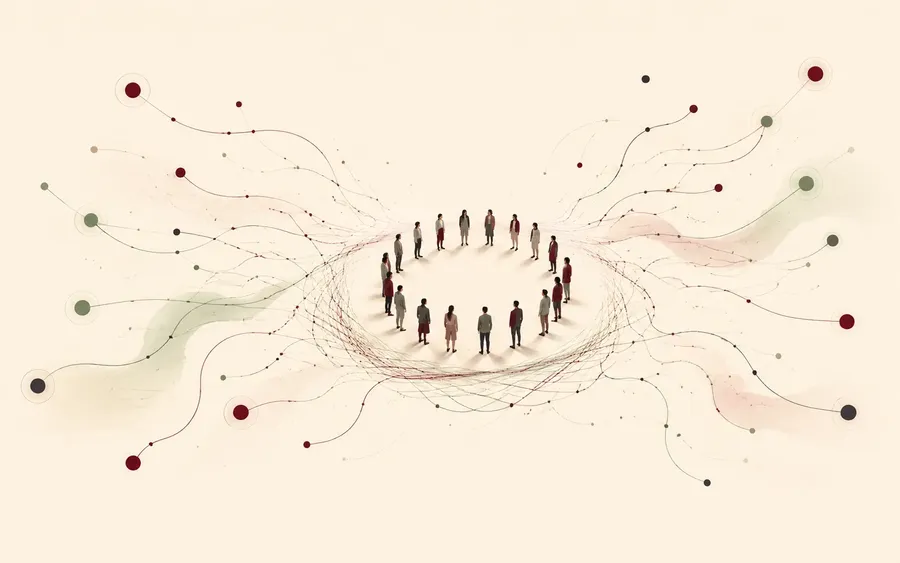
A narrative may first attract the attention of a few people, then enter their conversations. They place their own experiences inside it, create shared words and symbols, and gradually feel that they belong to something larger than themselves. If this shared identity can generate behaviour, choice, or collective action, then more than a meme has replicated: a narrative and identity network has formed that can reproduce itself.
That is what I call a WEME.
A meme is something we repeat; a WEME is something within which we come to see ourselves as a ‘we.’
Meaning Must Travel Beyond Its Creator
Like roots, rivers, and lungs, a WEME needs main pathways, intermediate branches, and local extensions. Major channels can carry a message to a large population, but smaller circles make it intimate, trustworthy, and livable. A public figure may retell a narrative to millions, yet a friend who connects it to a group’s shared experience can sometimes leave the deeper mark.
This may explain why some ideas disappear despite enormous promotion, while others live for years without their creator remaining at the centre of the stage. The second kind has found a way to move beyond its first owner. It is no longer merely stated; other people retell, interpret, and live it.
A WEME is not necessarily born when it is first expressed. It may not be born even after thousands of people have seen it.
Its real birth may occur when someone explains the narrative to another person in their own words; when a circle of people finds a shared sign; when meaning leaves the page and appears in their relationships, choices, or behaviour.
At that moment, the narrative no longer belongs only to its creator. It acquires a life of its own.
A lung works only when air moves beyond the trachea and reaches the most distant branches. A tree survives only when water does not stop in the trunk. A river changes geography only when its flow continues.
A WEME comes alive when meaning moves beyond its creator, flows through a network of people, and continues to shape relationships, identity, and action even in the creator’s absence.
Perhaps the secret of influence is not always to make a voice louder. Sometimes it is to build a longer path for meaning.