How Knowledge Became Fragmented
Modern knowledge advanced largely through one powerful move: divide a complex problem into smaller parts, measure each part carefully, and use that understanding to explain the whole. This method enabled us to calculate planetary motion, observe the machinery of the cell, distinguish one disease from another, and build technologies that once seemed impossible.
Specialization is a product of this intellectual division of labour. No one can master every detail of physics, biology, economics, psychology, and philosophy at once. Knowledge was therefore divided into disciplines, disciplines into fields, and fields into increasingly narrow problems. The division produced depth and precision—but every division also carries a risk: we may mistake the boundaries we created for study for the actual boundaries of the problem.
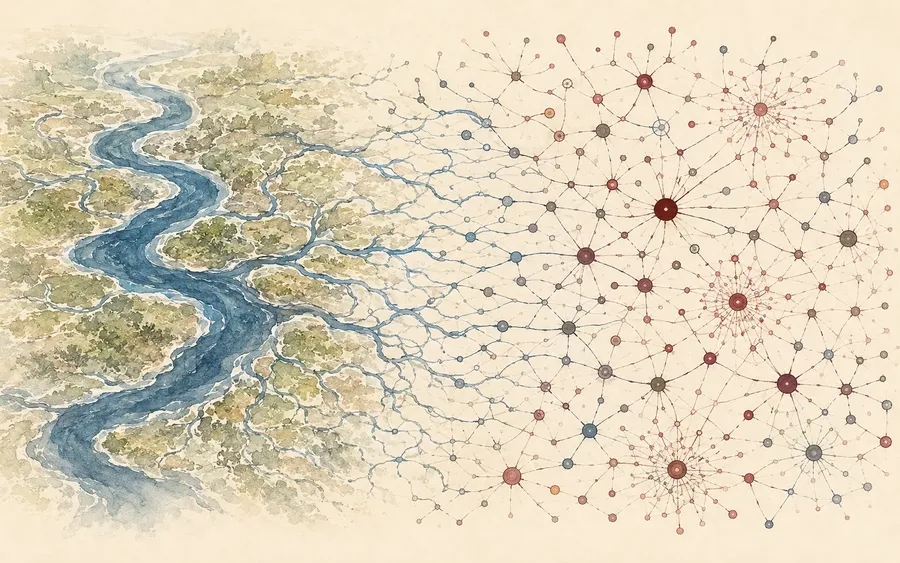
When we divide the world into a thousand pieces, each piece may become clearer while the relationships among them disappear. The trees come into focus, but the forest fades.
Newton and the Power of Analysis
Newton’s prism experiments are among the clearest demonstrations of analytical power. He showed that light which appears white can be separated into a spectrum of colours, and that those colours have different degrees of refrangibility. A seemingly unified phenomenon became a set of measurable components, revealing an order hidden within it.
Newton’s Opticks, first published in 1704, offered more than a collection of answers; it offered a model for asking questions. Place a phenomenon under controlled conditions, restrict the variables, break it into parts, and ask about testable relationships. This method remains one of the indispensable foundations of science.
Yet the power of decomposition can tempt us to assume that knowing everything about the parts necessarily tells us everything about the full experience of the phenomenon. This is where Goethe enters the story.
Goethe and the Experience of Colour
In Theory of Colours, published in 1810, Goethe did not ask only what light was made of. He wanted to know how colour arises in human experience: what role the eye plays, how the meeting of light and darkness changes what we see, how afterimages form, and how context transforms perceived colour.
The difference was not merely a dispute over the result of an experiment; it concerned the level of the question. Newton asked about the physical behaviour of light. Goethe focused much of his attention on colour as a phenomenon arising through the relationship among light, darkness, environment, and observer. Goethe’s physical theory did not replace Newtonian optics, and contemporary science stands closer to Newton in explaining the structure of light. Still, Goethe’s sensitivity to perception, context, and experience highlighted questions that decomposing light alone cannot answer.
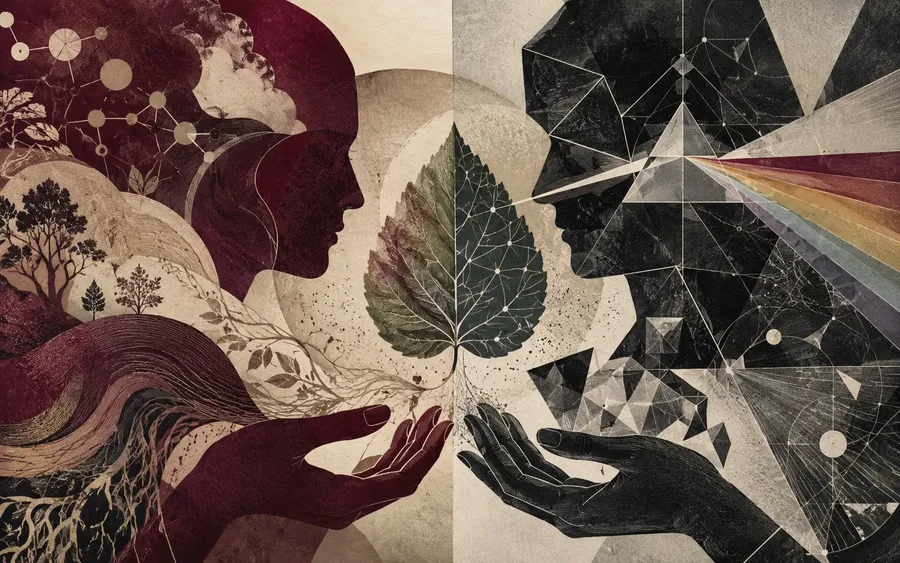
Newton and Goethe should not be reduced to simple labels—one the hero and the other mistaken, or one the scientist and the other the poet. Together they open windows onto two complementary levels of understanding: the parts themselves and the relationships through which those parts acquire meaning.
Reductionism: Its Power and Its Blind Spot
In its simplest form, reductionism says that to understand a complex whole, we must know how its component parts work. This is neither a mistake nor something we should abandon. Medicine cannot advance without understanding tissues and cells; psychology cannot advance without studying brain and behaviour; technology cannot advance without knowing its basic elements and rules.
The blind spot appears when reductionism moves from a useful method to a total claim: that an account of the parts is always sufficient to explain the whole. Many important properties of a system emerge only in relationships among components. A single neuron does not think, one word does not create a culture, and an individual isolated from relationships is not yet a society.
If we search for everything only in the smallest possible unit, we may lose sight of structure, history, context, and feedback. The resulting explanation can be rich in detail and poor in meaning.
Holism: Seeing Relationships, Context, and Emergence
Holism reminds us that a system is more than a list of its parts. Arrangement, relationships, feedback loops, and environment can create properties found in no single component. Systems theory calls these emergent properties: patterns that appear at the level of the whole.
But holism can fall into another trap when it remains vague. Saying that ‘everything is connected to everything’ is not yet a scientific explanation. A holistic view becomes useful when it identifies the important relationships, the system’s boundary, the scale of analysis, and the feedback mechanisms with precision.
Holism is not opposed to analysis. It does not ask us to discard detail; it asks us, after examining the details, to ask again which network contains these parts, how they alter one another, and what emerges at the level of the whole.
Reductionism asks how each part works; holism asks what the relationships among the parts bring into being.
A Choice We Should Refuse
The point is not to choose between Newton and Goethe, analysis and experience, or reductionism and holism. The real task is to choose the right level for the right question. To measure wavelength, we need the instruments and language of physics. To understand how a colour combination makes an audience feel, we must also consider perception, cultural context, and design.
Professional knowledge is formed in the movement between these two positions: moving closer to see the mechanism and stepping back to see the pattern. Each is incomplete without the other. Holism without expertise can remain superficial and poetic; expertise without holism can solve, with great precision, a problem that is no longer the real problem.
Today’s Problems Live at the Boundaries
Climate change is not only a problem of meteorology; it simultaneously involves economics, politics, energy, psychology, and culture. Artificial intelligence is not merely a software-engineering problem; it engages ethics, education, law, labour markets, public trust, and even the meaning of being human. Education is not limited to teaching methods either: brain, identity, technology, inequality, family, and organizational design meet within it.
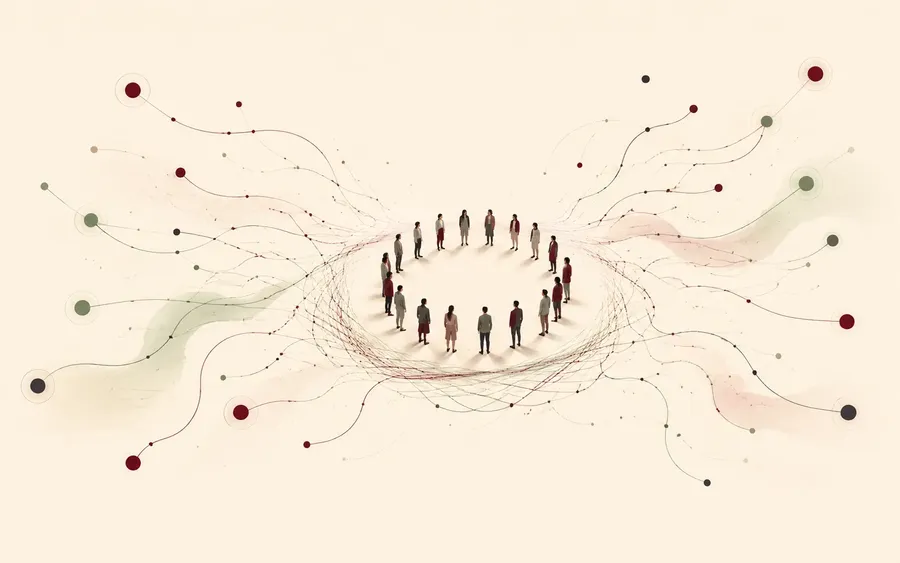
These problems do not respect the divisions of knowledge. Each specialist may correctly explain part of them, but no part alone forms the complete picture. Somewhere, findings must be translated into one another’s languages, conflicts among goals must become visible, and decisions must account for consequences at several levels.
That is why specialization alone is no longer enough—not because depth has lost its value, but because the value of depth becomes visible when it can connect with other depths.
What Can the Specialist of the Future Do?
The specialist of the future is not someone who knows a few terms from every field. Breadth does not mean collecting labels or moving superficially among disciplines. The starting point remains a central problem and a deep foundation; the difference is that this person does not confine the question to the border of one discipline.
They can identify the hidden assumptions of their own field, understand the language of other specialists, move between individual and collective scales, and turn precise data into a picture that supports decisions. Most importantly, they know what they do not know and when collaboration with another field is necessary.
Universities are still often organized around separation: physics in one building, psychology in another, and literature somewhere farther away. The real world, however, travels through the corridors between these buildings. Building bridges among these islands may be one of this century’s most important skills.
We do not have to choose between depth and breadth; we must go deep without forgetting the connections.